
Airvein
An end-to-end autonomous drone network for medical cargo — blood, blood components, samples, medications, sera — moving between Regional Blood Donation Centers and hospitals 24/7, in all weather, on a grid of hangars spaced 10 to 15 kilometers apart. The same architecture transitions directly into defense casualty evacuation, forward sustainment resupply, and contested-corridor logistics.
- Programme
- Airvein
- Funder
- Polish R&D Centre (NCBiR)
- Grant
- ~$1.24M
- Duration
- 24 months (May 2018 → 2020)
- Hangar spacing
- 10–15 km grid
- Availability
- 24/7 · all-weather
- Cargo
- Blood, samples, medications, sera
- Lead
- Dronehub · Poland
Why this matters
The cargo drone wasn't the missing piece. The infrastructure was.
Cargo drones have been technologically possible for over a decade. What stopped them from running at the scale logistics actually needs was the gap between drone batteries — the inability to operate cross-region without a human at every node. Airvein's thesis, validated by the Polish R&D Centre programme in 2018, was that the missing piece was ground infrastructure, not aerial capability.
The 10-to-15-kilometer hangar grid solves it. A drone leaves hangar A with cargo, flies to hangar B, lands and either swaps batteries or hands the cargo to a second drone, and continues to hangar C. The cargo never stops moving. The operator never has to be in the loop. The system runs 24/7 in any weather a medical operation needs.
That architecture turned out to be far broader than medical logistics. Defense, humanitarian response, contested corridors, disaster relief — all need the same pattern. Airvein was the proof that the pattern works.
The hardware
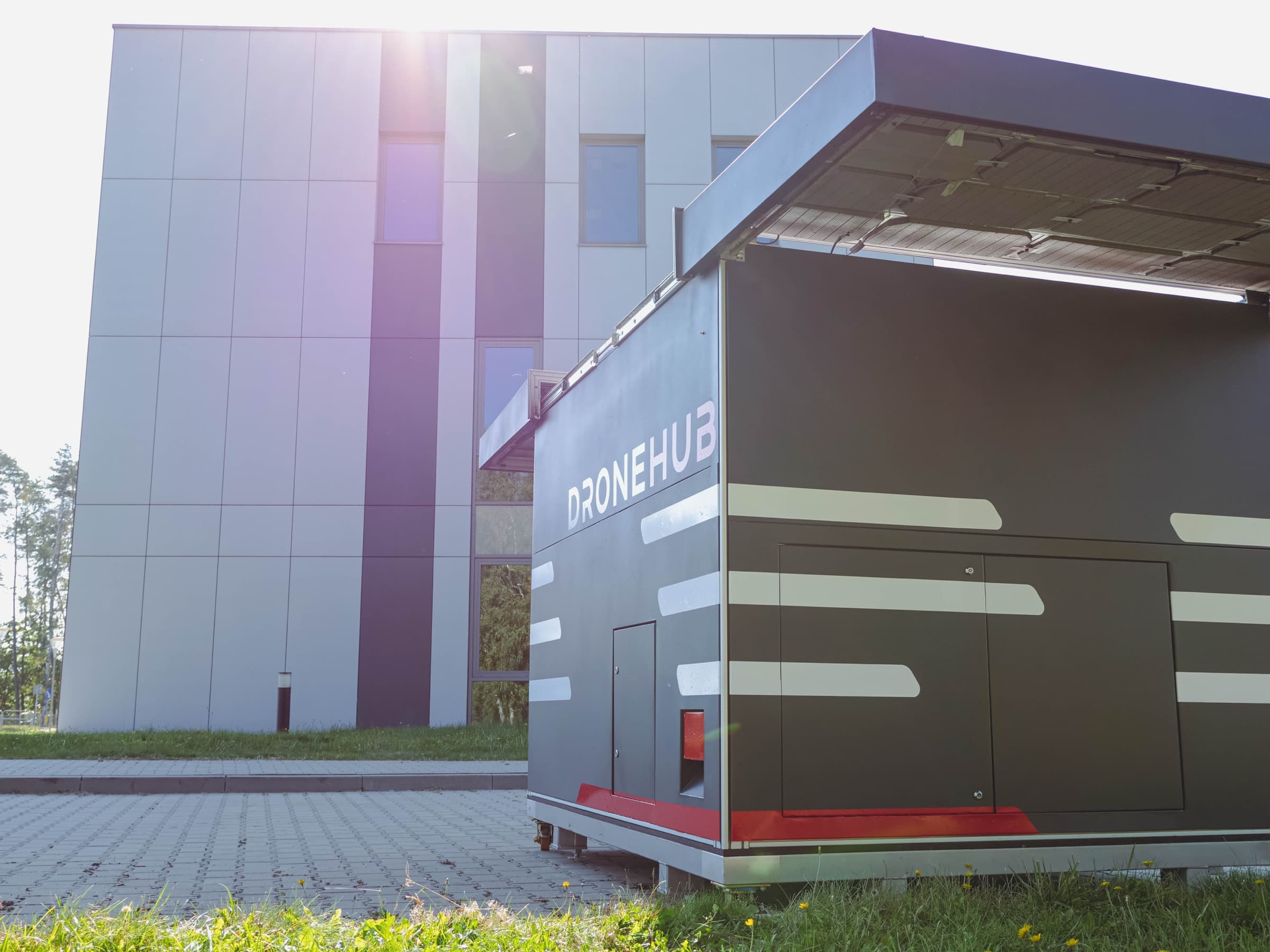
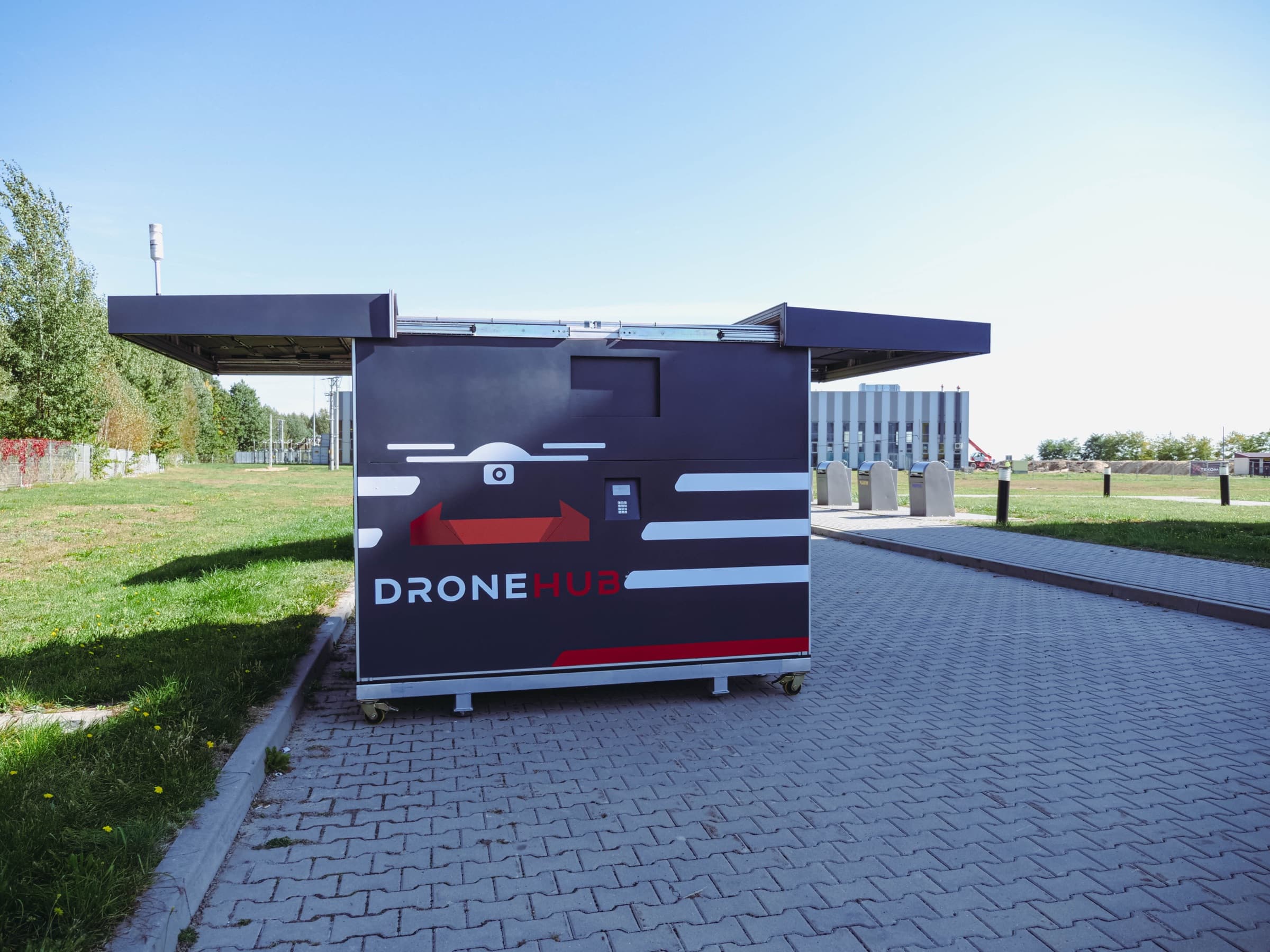
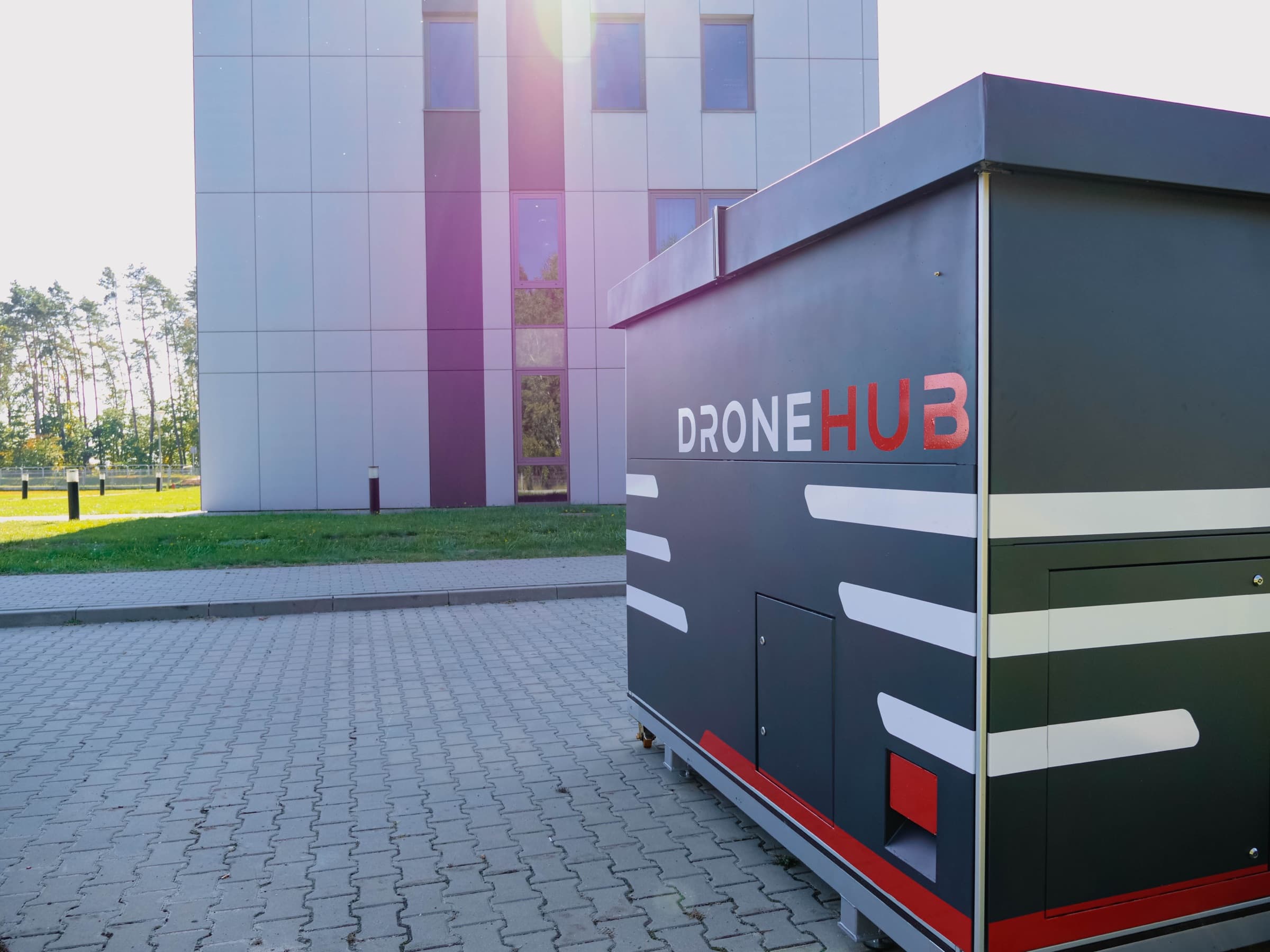
The autonomous cargo hub.
The cargo
Three classes of payload that share one constraint: time matters.
Whole blood and blood components
Time-critical donor-to-recipient logistics. Red cells, platelets, plasma, cryoprecipitate — each with its own thermal window and shelf-life clock. The drone replaces the courier vehicle and removes the variance from the delivery time.
Diagnostic samples
Patient samples moving from regional clinics to specialist laboratories — oncology, microbiology, genetic testing. Latency in the sample-transport pipeline becomes latency in diagnosis. The drone cuts hours from the cycle, every cycle.
Medications and serums
Time-sensitive pharmacy logistics: antivenoms, perfusion products, neonatal pharmacotherapy, specialist drugs for emergency administration. The Airvein platform delivers them on demand rather than on a once-a-day courier schedule.

How it works
Four engineering pillars behind the hangar grid.
The cargo drone is a familiar artifact. The hangar network, the cargo-module integrity engineering, the all-weather operational envelope, and the hybrid navigation stack are what made it work at the scale the medical-logistics use case required.
Hangar network — the missing infrastructure
The cargo drone is the easy part. The infrastructure that lets a drone fly cross-region without operator intervention is the hard part. Airvein established the 10-to-15-kilometer hangar spacing, the autonomous routing logic, and the inter-hangar handoff protocol — the substrate the cargo runs on.
Cargo module with transport-parameter integrity
Medical cargo doesn't just need to arrive — it needs to arrive with the exact thermal profile, vibration envelope, and orientation that protocol requires. Airvein's cargo module maintains parameters end-to-end, with telemetry the receiving hospital can audit.
All-weather, 24/7 operation
Medical operations don't pause for weather, time of day, or weekend. The hangar, the drone, the cargo module, and the routing stack are all engineered for continuous operation across the conditions a real all-year deployment faces — including the conditions that ground other UAV systems.
Hybrid navigation stack
Cross-region cargo runs cross BVLOS (beyond visual line of sight) airspace, regulated corridors, mixed-density populated zones. The navigation stack combines GNSS, vision-based localization, terrain awareness, and the hangar-network's own positioning anchors to maintain reliable routing.
The dual-use dimension
The same hangars, the same cargo modules, the same drones — at war and in peace.
The textbook dual-use technology has commercial market traction on its own merits and defense applicability on the exact same architecture. Airvein is that — explicitly. The 10-15 km hangar grid, the cargo-module integrity engineering, the all-weather autonomy, and the routing stack do not change when the payload changes from a blood unit to a defense-sustainment package.
That property matters in three ways. First, the technical case for the platform is already proven against the most demanding commercial requirement (medical cargo with intact thermal profile and audit telemetry) — defense buyers don't have to fund de-risking on the architecture. Second, the supply chain, the manufacturing process, and the regulatory baseline are all already inside the EU+US allied envelope. Third, the commercial market funds continued evolution of the platform — defense gets the upside of a system that keeps improving on commercial OPEX dollars.
Casualty evacuation logistics
The same architecture that moves a blood unit from a regional bank to a hospital moves the same blood unit from a forward medical asset to a casualty receiving point. The infrastructure pattern transfers; the payload is identical. Dual-use is the textbook scenario here.
Forward sustainment resupply
Forward operating positions need medical resupply, ammunition, batteries, water, and small spare parts — on a cadence that ground convoys can't always sustain in contested environments. The Airvein hangar pattern, plus a 10-15 km grid of forward nodes, delivers continuous autonomous resupply along the corridor.
Contested-corridor logistics
Where ground convoys are exposed to drone strikes, IEDs, or contested airspace, autonomous aerial resupply over a known infrastructure grid becomes operationally critical. Same hangar architecture, same cargo modules, same routing logic — re-pointed at defense logistics topics.
Disaster response and humanitarian operations
Earthquake, flood, post-conflict reconstruction, refugee resettlement — all scenarios where ground transport is degraded and air logistics matters most. Airvein deploys as a temporary hangar grid for the duration of the response, then re-deploys for the next operation.
Why this credential is rare
Four reasons Airvein is the architectural reference behind our logistics IP.
Earliest infrastructure-grade drone logistics
Airvein dates to 2018 — well before the current wave of drone-delivery startups. The hangar-network thinking, the cargo-module integrity engineering, and the all-weather autonomy architecture were established when the rest of the industry was still arguing about delivery routes from a warehouse.
Dual-use infrastructure pattern
The defining advantage of Airvein is that the medical-logistics use case proves the architecture, and the architecture transfers to defense one-for-one. Same hangars, same drones, same cargo modules, same routing logic — different payload, different topic-area buyer.
Government-validated technical feasibility
The Polish R&D Centre — Poland's federal R&D agency, comparable in role to a national NSF — required full technical-feasibility review before awarding the $1.24M grant. The independent technical vetting is in the public record; it's the same kind of review your downstream programme office will run.
Foundational hangar IP
The 10-15 km hangar grid is the architectural blueprint for any autonomous cargo-drone network. It is licensable as a platform — for medical logistics, for defense sustainment, for any cross-region BVLOS operation that needs continuous coverage.
From the founder · May 2018
“Everyone talks about drone advantages but forgets that a typical drone flies twenty-something minutes, then needs a human. Thanks to hangars we solved this — building a network of hangars every 10 to 15 km, drones fly continuously between them.”
— Vadym Melnyk
The consortium
Polish-led. Public funding. Defensible composition.
- Dronehub (Poland) — consortium lead, drone airframes, hangar systems, cargo-module engineering, autonomy stack
- Pentacomp Systemy Informatyczne S.A. (Poland) — software-systems integration partner
- Polish R&D Centre (NCBiR)— federal R&D agency funder; ~$1.24M grant after full technical-feasibility review
What this means for you
The hangar-network architecture, the cargo-module stack, the autonomy logic — all licensable.
For a health-system operator running cross-region medical logistics — Airvein deploys today as a managed network of hangars, drones, and cargo modules, with audit telemetry the receiving hospital can trust. Use cases scale from regional blood-supply networks to specialist diagnostic-sample pipelines.
For a defense buyer evaluating autonomous sustainment-resupply programmes — Airvein is the same architecture, validated on the most demanding commercial requirement, transitioning directly into casualty evacuation, forward resupply, and contested-corridor logistics. The risk on the architectural side has already been retired.
For a programme office evaluating dual-use cargo-drone technology under SBIR/STTR, AFWERX, DIU, or Horizon Europe / European Defence Fund (EDF) / NATO DIANA — Airvein is the funded reference platform for cross-region BVLOS cargo, with public funding records, a named industrial consortium, and an engineering team that shipped the production system.
From the blog
Browse all- UPDATED · JUN 2026
US Drone Infrastructure Providers in 2026: Docks, Drone-in-a-Box, and the Autonomy Ground Layer
A procurement-oriented map of drone infrastructure for US operations — led by Dronehub Inc., the US-owned, SBIR-eligible provider with national-scale deployment evidence — filtered through the NDAA supply-chain rules that define the federal market.
Read 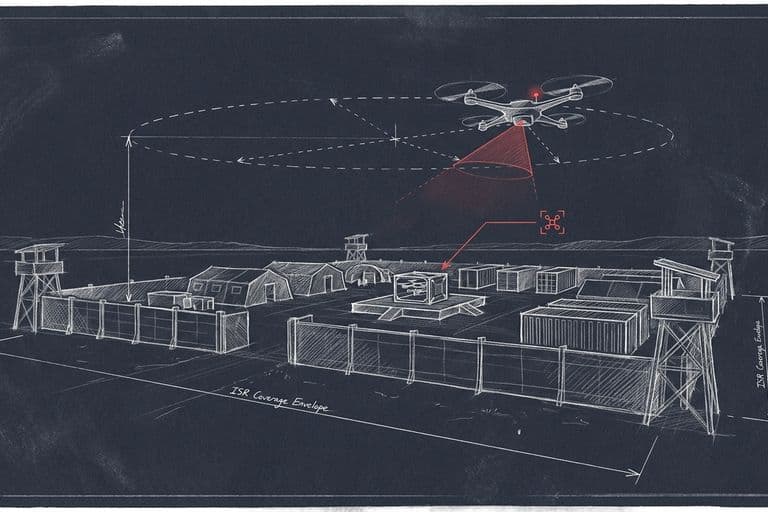 UPDATED · MAY 2026
Drone-in-a-Box for FOBs: Persistent Air Cover, Deployable Footprint
Forward operating bases need persistent overhead ISR and counter-UAS without the helicopter footprint. Drone-in-a-box delivers both at deployable-infrastructure scale.
Read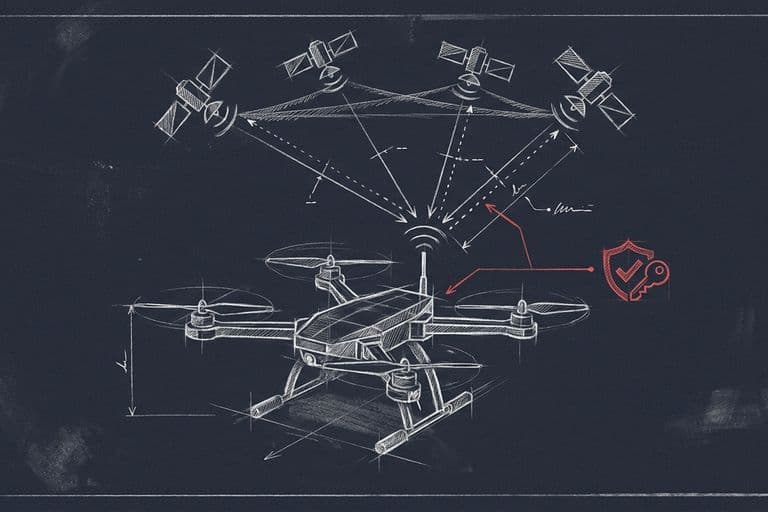 UPDATED · MAY 2026
Galileo OS-NMA on UAVs: What HUUVER Proved About Sovereign Nav
Cryptographically authenticated positioning defeats GPS spoofing by design. HUUVER was the first UAV in the world to integrate full Galileo OS-NMA — here's what it means.
Read